
Beijing
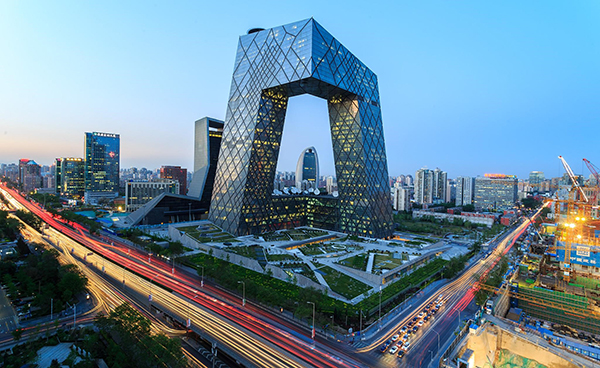
Beijing, previously romanized as Peking, is the capital city of China. Beijing Municipality covers an area of 16,410.54 square kilometres (sq.km). Nestled on the north of the North China Plain, it borders Tianjin Municipality on the east and Hebei Province in all other directions. The Western Hills, west of Beijing, are branches of the Taihang Mountains while the Jundu Mountain, north of the city, is a part of the Yanshan Mountains. They intersect at Beijing's Guangou Valley, shaping a giant semi-circle curve opening to the southeast. This curve is called "Beijing Bay." All these tell us why Beijing has been acclaimed as a land of peace and prosperity since ancient times.
Forbidden City
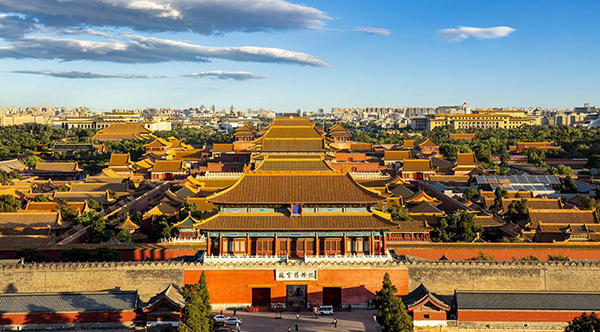
Located on Beijing Central Axis, the Forbidden City was the palace city of the Ming and Qing dynasties. Its location in relation with the old city of Beijing epitomizes the ancient Chinese concept of urban planning of "building the imperial palace at the central location". The imperial court area formed by the Tian'anmen Gate, the Upright Gate, and the Forbidden City, together with the Bell and Drum Towers in the north exhibit the urban planning paradigm of "court in the front, market in the back" as prescribed in the Kaogongji. The Forbidden City is an outstanding example of the imperial palace in China. The centered and symmetrical planning pattern and the well ordered landscape demonstrate the principle of "choosing the center." It was a place where the imperial families hosted national celebrations, administered government affairs, and enjoyed daily activities. As a significant material, carrier of national etiquettes and cultural traditions, the Forbidden City has witnessed the Chinese cultural tradition of inclusion and diversity.
Badaling Great Wall
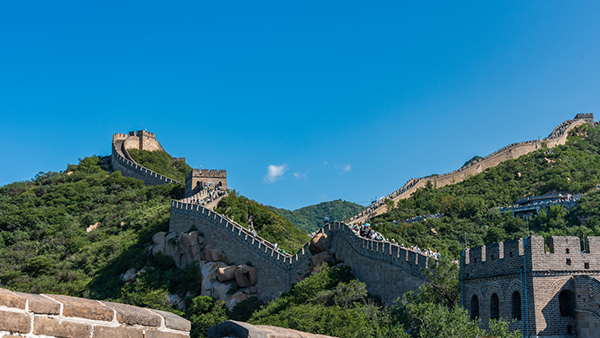
The Badaling Great Wall is located on the ridge of the northern part of the Guangou. Here, two peaks come face to face, and there is an alley between the two, strategically placed. Due to the importance of the Badaling, it became the place where military fought. It became the martial stronghold from the Spring and Autumn Period and the Warring States Period. It was rebuilt in the Ming Dynasty where it was no longer a mere wall, but a rigorous recovery system. Ningxia, Shaanxi, Shanxi, Hebei are all in the Great Wall's path. Many Guan cities and short walls were built in these pivotal places. Since the Qing Dynasty, the Badaling Great Wall has become more deserted. The city towers to the west of Guan city had severely been destroyed. After the State Department decided to repair it, the Great Wall had been rehabilitated several times.